

By Pao-Chien Wang, Professor in the Department of Hakka Language and Social Sciences, National Central University, Taiwan

Since the publication of Introduction to Hakka Studies by Hsiang-Lin Lo in 1933, the origins of the Hakka people have remained a pivotal topic in Hakka research. Initially framed as a dichotomy of “northern Han Chinese vs. southern indigenous people,” the debate has evolved through various theories. These range from the “Central Plains Hakka / She-Hakka equivalence / Yue people Sinicization” tripartite model to a more nuanced six-theory framework: “northern Han Chinese / northern Central Asian ethnic groups / northern Han Chinese dominance / Han-indigenous fusion / southern Han Chinese dominance / southern indigenous dominance” (Chao-Jin Lo, 2018; Wei-Te Hsu, 2021). This evolution underscores the complexity of Hakka origins.
These academic discussions have practical implications, particularly in defining the target groups for Hakka-related policies within state frameworks. Clarifying “Who are the Hakka?” and “How should Hakka people be defined?” becomes essential. In 2010, Taiwan enacted the world’s first Hakka Basic Act, a legal framework centered on Hakka identity.
According to Article 2, Clause 1 of the Hakka Basic Act, “Hakka people refer to those with Hakka lineage or origins, who also self-identify as Hakka.” Based on this definition, Hakka identity can be determined through three key elements – “Hakka lineage,” “Hakka origins,” and “Hakka self-identification” – and recognized in two distinct forms:
- Those with Hakka lineage who self-identify as Hakka.
- Those with Hakka origins who self-identify as Hakka (Bao-Jian Wang, 2018: 134-135).
This framework highlights the interplay between heritage, cultural ties, and personal identity in defining Hakka people within modern legal and social contexts.
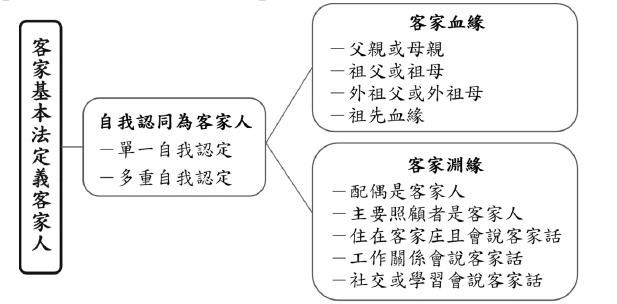
In the context of ethnic identity, primordialism refers to the “innate” characteristics of shared ancestry, language, and culture as visible “external” features. On the other hand, instrumentalism emphasizes “subjective” aspects of identity, such as shared history, experiences, and memories, leading to a sense of “self-identification” (Bao-Jian Wang, 2018: 134). The Hakka Basic Act adopts a hybrid approach, recognizing Hakka identity through both primordial and instrumental perspectives.
This inclusive framework means that many Hakka descendants in Jamaica, despite intermarriage and integration into local communities – resulting in differences in physical appearance and language – can still be recognized as Hakka if they self-identify as such. Even if they do not speak Mandarin or Hakka, their pride in declaring, “I am Hakka” in English affirms their identity as Hakka.
References:
- Bao-Jian Wang (2018). The Legal Framework for Hakka Development. Taoyuan: National Central University Press.
- Hakka Affairs Council (2022). 2021 National Hakka Population and Language Data Survey. New Taipei City: Hakka Affairs Council.
- Wei-Te Hsu (2021). “Classification and Review of ‘Hakka Origins’ Literature: An Attempt at an ‘Ideal Type’ and ‘Continuum’ Concept.” Global Hakka Studies, 16: 9-78.
- Chao-Jin Lo (2018). “The Key to Unraveling Hakka Origins.” Hakka Studies, 11(2): 1-32.
 English
  Chinese