
By Pao-Chien Wang, Professor in the Department of Hakka Language and Social Sciences, National Central University / Deputy Dean in College of Hakka Studies / Director of Language Equality and Policy Research Center

A few years ago, Taiwan Public Television Service and the Hakka Affairs Council co-produced the popular drama Gold Leaf, set in Beipu, Hsinchu, which tells the story of a tea merchant family. In one scene, the female lead, Yi-Hsin Chang, attempts to replace her late-arriving father in performing ancestor worship. However, her uncle dismisses her, saying that a woman cannot represent the family lineage. Yi-Hsin counters, arguing that, like her male relatives, she shares the Chang surname and respects their ancestors, so why can’t she perform the ritual?
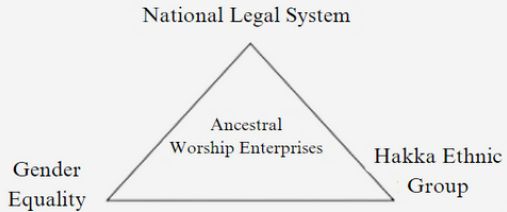
This scene highlights the conflict between gender equality and traditional customs. While Taiwan’s Civil Code guarantees equal inheritance rights for men and women, gender inequality persists in certain cultural areas, especially regarding ancestral worship. Traditionally, only the eldest son can inherit the rights to ancestor worship and related property, excluding women. This practice is reflected in Taiwan’s folk customs, where ancestral worship enterprises are typically inherited by men, leaving women without equal rights.
Hakka people in Taiwan, who originally migrated from China, established ancestral halls and created “ancestral worship enterprises” to conduct rituals and preserve family heritage. These enterprises, which include ancestral halls and towers, also function as centers for family unity and the transmission of cultural identity.
To address gender equality issues and improve land management, the Ancestral Worship Enterprise Act was enacted in 2007. While the Act ensured women’s equal inheritance rights, traditional practices still influence the inheritance of these enterprises. Women’s ability to inherit may depend on their participation in ancestral rituals, and married women’s right to return to their natal homes for worship remains constrained by tradition.
This issue represents both a challenge to gender equality and the enduring influence of traditional customs on family inheritance. It remains an area requiring further discussion and reform in modern society.
References:
- Wang, P.-J. (2007). Can you inherit the ancestral worship corporation? Liberty Times.
- Wang, P.-J. (2021). Gender equality and language use in Taiwan’s Hakka ancestral worship corporations. Research project funded by the Hakka Affairs Council.
- Wang, P.-J. (2022). Language use among members of Hakka ancestral worship corporations. In W.-A. Chang (Ed.), Hakka and interethnic relations (pp. 99-126). Hsinchu: National Yang Ming Chiao Tung University Press.
- Hakka Affairs Council, Hakka Culture Development Center. (2019). Hakka society rituals: Discussions on ancestral tablets, ancestral towers, and female ritualists.
- Lo, L.-S. (2013). Hakka clans and ancestral hall construction. Taiwan Journal of Studies, 78, 12-15.
 English
  Chinese